Incandescent vs. LED: Beautiful Light, Better Evenings
What 2700K, 3000K and 5000K really mean, and how to choose lighting that balances atmosphere, comfort and energy efficiency.
You can choose the right paint, find a beautiful sofa and spend weeks getting the details of a room just right. Then evening comes, you switch on the lights, and something feels wrong. The walls look different. The room feels flat. A space that was inviting during the day suddenly seems too sharp or too yellow.
From a designer’s perspective, lighting belongs in the first conversations about a home. It changes how we experience colour, texture and space. It also deserves attention beyond appearances, particularly as the day moves towards bedtime.
The useful question is not simply whether incandescent or LED is better. It is how to choose and use light well.
What we miss about incandescent light
An incandescent bulb produces light by heating a filament. Its familiar warm glow has shaped our idea of a comfortable evening at home. It also becomes warmer in colour as it dims, a quality that suits intimate dining rooms and quiet bedrooms.
LEDs produce light using semiconductor technology and use much less electricity for comparable light output. But “LED” describes the technology, not one particular appearance. An LED can look warm and gentle or cool and crisp. Some are excellent at rendering colours; others are less convincing.
Standard dimmable LEDs generally reduce brightness without reproducing the colour change of an incandescent bulb. Look for dim-to-warm or warm-dim if you want that effect. These products are designed to become warmer as the output falls, although their ranges and performance vary. [1]
Where incandescent light still shines: the bedroom
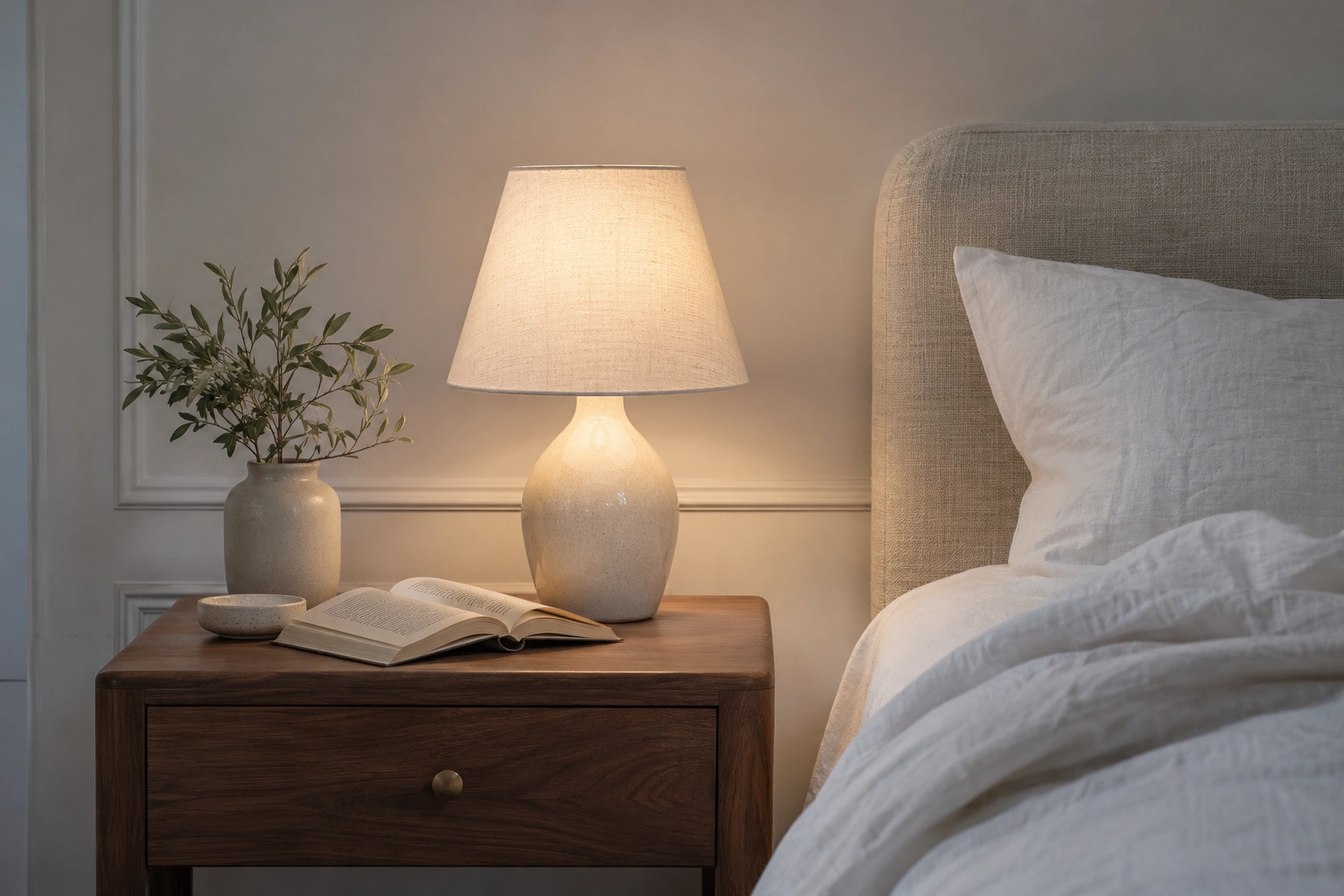
There is a reason a gently dimmed incandescent bedside lamp can feel so pleasant. Its warmth deepens as the light level falls, and its smooth dimming makes it easy to move from reading to a quieter evening setting. For someone who already enjoys a suitable incandescent lamp, these remain real design advantages. [1]
That does not call for replacing good LEDs throughout the house. Incandescent bulbs use more electricity, and a carefully chosen warm-dim LED can offer a similar atmosphere with much lower consumption. I would choose a bedside light by its comfort, shielding and dimming performance, alongside its colour and efficiency. The aim is to preserve the qualities we enjoy, not to prescribe one technology for every home.
Is incandescent light continuous while LED light flickers?
There is an important distinction here. An incandescent filament stays hot between the fluctuations of an alternating-current supply, smoothing its light output. It can still have a small amount of flicker; it is not perfectly constant. LEDs respond much faster to changes in current, so their steadiness depends strongly on the driver electronics and dimmer. Well-designed LEDs can have very low flicker, while poor or incompatible combinations can produce pronounced fluctuations. [9]
Flicker is variation over time. It is different from the distribution of wavelengths in a light’s spectrum. A smooth spectrum and steady light output are separate qualities.
For a bedroom, low-flicker performance is a worthwhile comfort criterion. However, the sleep research discussed below does not establish that incandescent bulbs improve sleep more than well-designed LEDs because of flicker. Visual comfort and circadian effects deserve separate consideration. A dim incandescent lamp may feel better than a poorly performing LED, but a warm, well-shielded, low-flicker LED can also be a good evening choice.
2700K, 3000K and 5000K: what changes?
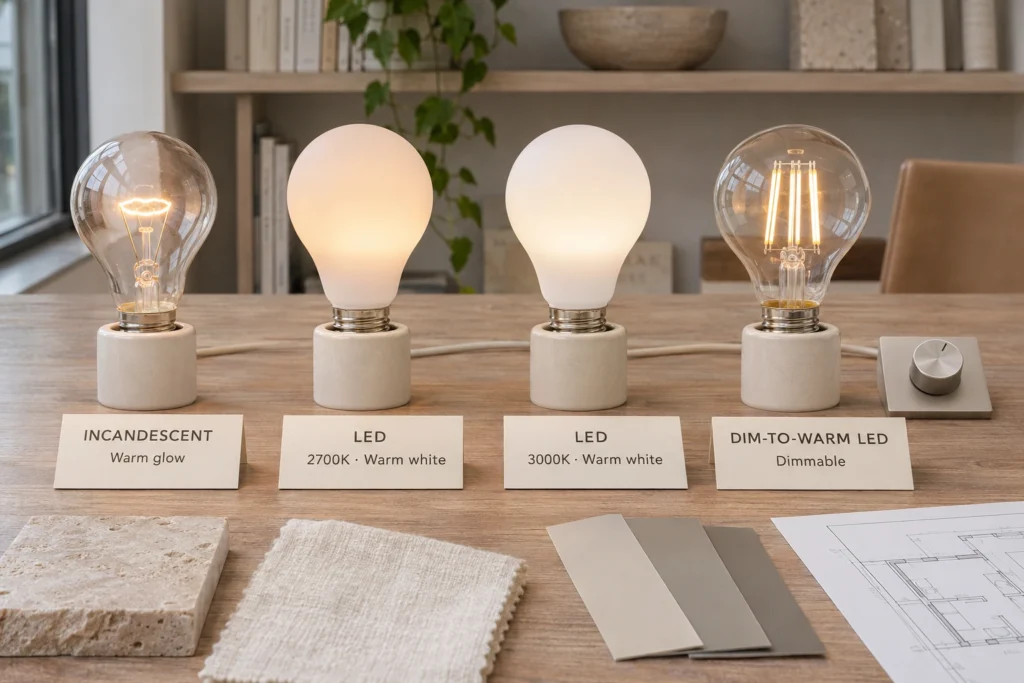
Kelvin describes the colour appearance of white light, usually called correlated colour temperature. Lower numbers look warmer; higher numbers look cooler. It does not tell you how bright a bulb is, how much power it uses or how accurately it renders colours. [2]
| Colour temperature | How it tends to look | My design starting point |
|---|---|---|
| 2700K | Warm white, close to the familiar appearance of many household incandescent bulbs. | Living-room lamps, dining spaces and bedrooms where a softer evening atmosphere matters. |
| 3000K | Still warm, with a slightly cleaner, less golden appearance than 2700K. | Kitchens, bathrooms and multipurpose spaces; also worth trying if 2700K feels too yellow. |
| 5000K | A cooler, daylight-like white, noticeably different from 2700K. | Selected daytime work or hobby areas where that appearance is useful, with a separate evening lighting option. |
These room suggestions are design choices, not medical thresholds. A 5000K bulb is not automatically brighter than a 2700K bulb: compare lumens for light output. Nor does “daylight” on a box mean that a bulb reproduces all the qualities or benefits of outdoor daylight.
In a home with warm wood, ivory upholstery and muted colours, I would begin by testing 2700K and 3000K in the actual room. Put a paint sample and a fabric swatch nearby. Look at them after dark, with the intended lampshade in place. The number on the box is a starting point; the finished room is the test.
What the research says about evening light
Light reaching our eyes helps regulate the body’s daily timing. Evening exposure can suppress melatonin, the hormone associated with biological night. The response depends on the spectrum, intensity, timing and duration of exposure—not simply whether the source is an LED. [3]
In a 2011 study, Joshua Gooley and colleagues examined 116 healthy adults aged 18–30. Compared with very dim light, room light before bedtime delayed melatonin onset in almost all participants and shortened the duration of melatonin production by about 90 minutes. That does not mean they slept 90 minutes less. This was a finding about melatonin under controlled conditions, not proof that a particular bulb causes insomnia. [4]
A 2022 expert consensus led by Timothy Brown recommended brighter days, substantially lower light exposure during the three hours before bedtime and a dark sleep environment for healthy adults. It uses a measure of light reaching the eye called melanopic EDI, rather than Kelvin alone. Two lights with the same colour temperature can have different biological effects. [3]What this means at home
A warm bulb can still be too bright for the late evening. Choosing 2700K is not a guarantee of better sleep; reducing exposure and considering when you use the light matter too.
The International Commission on Illumination’s 2024 position statement supports this day-to-night approach while emphasising visual comfort, glare control, energy use and architectural design. Good lighting needs to serve these goals together. [5]
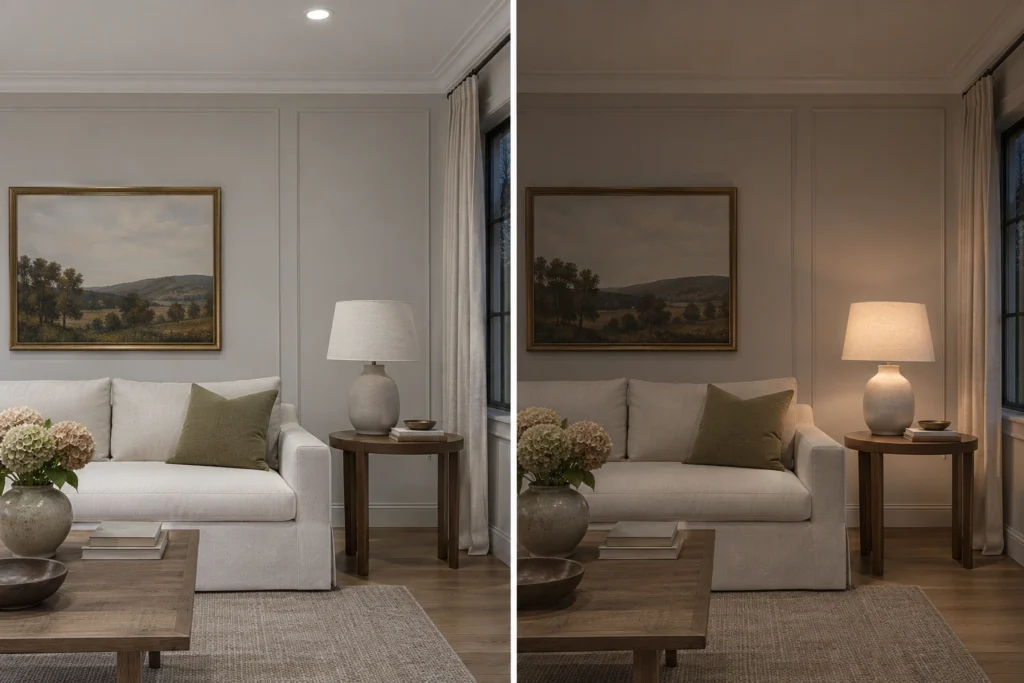
A home that changes with the time of day
My design translation is to give a room more than one setting. A kitchen needs enough light for chopping and cleaning. Later, that same space may only need a gentle background glow while the family sits nearby.
Layering: ambient, task and accent light
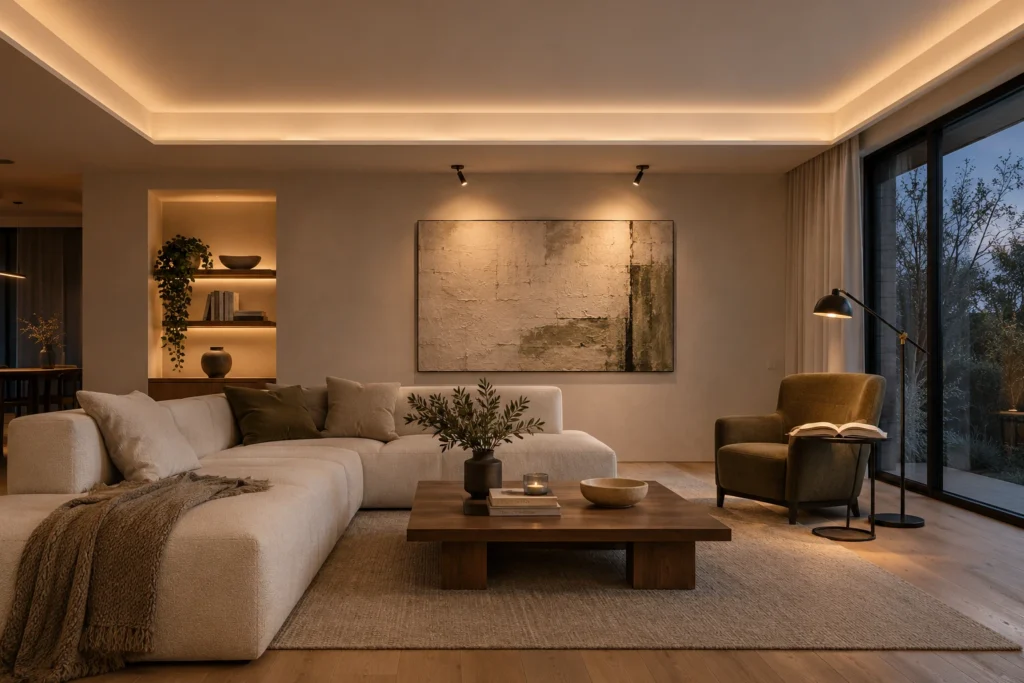
Layering means giving light different jobs, with enough control to choose which ones you need. It does not mean adding more fixtures or keeping them all on.
| Layer | Purpose | Examples at home |
|---|---|---|
| Ambient lighting | The overall background light that helps you see and move comfortably. | A diffused ceiling fixture, indirect lighting or a combination of shaded lamps. |
| Task lighting | Focused light for a particular activity. | A bedside reading lamp, desk lamp or under-cabinet light over a kitchen worktop. |
| Accent lighting | Light that draws attention to a feature and adds depth. | A picture light, a softly lit niche or a restrained wash of light on a textured wall. |
A single fitting can serve more than one role. A shaded bedside lamp, for example, may provide both reading light and some ambient light. Decorative fixtures contribute visual character, but should also be judged by the useful light they deliver.
In a bedroom, I would plan general light for dressing and cleaning, independently controlled reading lights, and optional accent lighting. As bedtime approaches, switch off the brighter general and accent layers and retain only the light you need. Aim reading light towards the page and away from your partner’s eyes. Separate controls let the room become quieter without leaving someone struggling to read.
In an open-plan home, keeping adjacent lights reasonably consistent in colour can help the space feel cohesive. You can still give evening lamps a warmer setting. Test the combination from the places where you actually sit, rather than choosing each bulb in isolation.
For the last few hours before bed, reduce unnecessary brightness and favour warm, shielded light. Position lamps so an exposed bulb does not sit directly in your line of sight. Keep enough light for reading and safe movement; a relaxing scheme should still be usable.
During the day, make use of daylight. At bedtime, switch decorative lighting off and reduce unwanted light entering the bedroom. If you need to get up at night, a low-level, shielded route light can be a practical compromise. These habits support an appropriate light–dark pattern; they are not a treatment for persistent sleep difficulties. [3]
Enjoy the glow, then switch it off
The visual warmth of incandescent light comes with actual heat. Traditional incandescent bulbs release about 90% of the energy they use as heat, which is a major reason for their poor efficiency. Their hot surfaces deserve care, especially near bedroom textiles. [10]
Use the bulb type and actual wattage specified for the fixture, never exceed its rating, and keep lamps and bulbs clear of curtains, bedding and other combustible materials. Never drape fabric over a lamp to soften its light. The U.S. Fire Administration specifically advises keeping combustible items away from lamps and matching bulbs to fixture wattage recommendations. [11]
Switch off bedside reading and decorative lamps before falling asleep, particularly hot-running incandescent lamps. This is a sensible bedtime habit for both darkness and avoiding unnecessary heat. A correctly used incandescent lamp is not automatically a fire hazard, and there is no single risk multiplier that applies to every incandescent-versus-LED comparison. Risk depends on the fitting, placement, condition and use. LEDs also require suitable fixtures and safe installation.
If a night light is needed for safe movement, use a purpose-designed, low-output LED positioned to keep direct light out of your eyes, ideally activated only when needed. Keep the rest of the sleep environment dark.
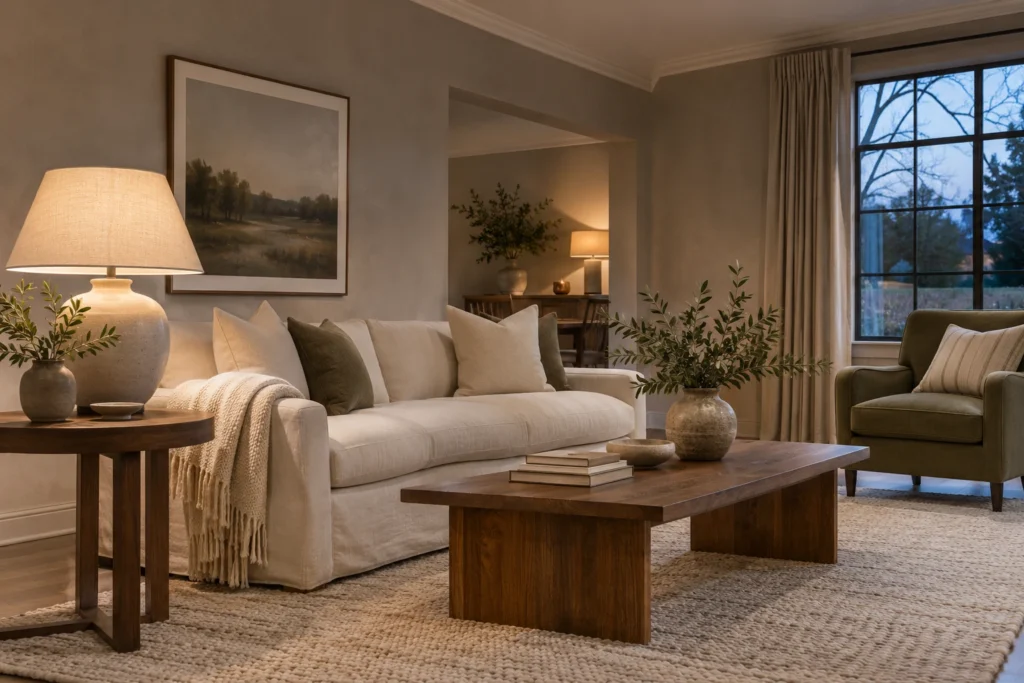
Efficiency should include the quality of the light
There is a strong energy case for LEDs. The U.S. Department of Energy describes LED lighting as capable of using at least 75% less energy and lasting much longer than incandescent lighting. Actual results depend on the product and how it is used. [6]
As a simple example, replacing a 60-watt bulb with a 9-watt LED of comparable output reduces electricity use by 85%. At three hours per day, that is about 56 kWh saved per year for one bulb. This is an illustrative calculation, not a promise for every replacement.
I would also look for CRI 90 or above when the appearance of artwork, textiles and finishes matters. CRI describes colour fidelity relative to a reference light source; it is separate from colour temperature and is not a sleep-health rating. The Canadian Conservation Institute recommends high-CRI LEDs for demanding museum applications, demonstrating that efficient lighting and good colour rendering can coexist. [7]
Then check the dimming. A bulb labelled “dimmable” still needs a compatible dimmer. LED light quality also depends on its electronics: poor combinations can produce flicker or unstable output. The Department of Energy identifies driver and dimmer performance as important factors in temporal light modulation. Ask for compatibility information and low-flicker performance across the intended dimming range, not just at full output. [8]
A short checklist before you buy
- Choose the appearance: test 2700K or 3000K for living spaces; use 5000K deliberately where it suits daytime work.
- Compare lumens: buy the light output you need, then compare watts for energy use.
- Check colour quality: CRI 90+ is a useful starting point for interiors.
- Plan the evening setting: check dimmer compatibility and consider dim-to-warm.
- Check the fitting: confirm the bulb is suitable for the fixture, including enclosed fittings where applicable.
- Try one first: assess colour, glare and dimming in your home before replacing every bulb.
A beautiful lighting scheme gives you choices: useful light when you are busy, a gentler atmosphere as evening settles in, and darkness when it is time to sleep. Thoughtfully chosen LEDs can be part of that home, bringing efficiency without giving up the qualities we value in good light.
Which do you prefer at home: the softer warmth of 2700K or the slightly cleaner look of 3000K?
Sources & further reading
- U.S. Department of Energy: Understanding LED Color-Tunable Products.
- U.S. Department of Energy: Consumer Guide to Energy-Efficient Lighting.
- Brown et al. (2022). Recommendations for daytime, evening, and nighttime indoor light exposure to best support physiology, sleep, and wakefulness in healthy adults. PLOS Biology.
- Gooley et al. (2011). Exposure to room light before bedtime suppresses melatonin onset and shortens melatonin duration in humans.
- CIE (2024). Position Statement on Integrative Lighting, 3rd edition.
- U.S. Department of Energy: Building Upgrade Guide—LED Lighting.
- Canadian Conservation Institute: LED Lighting in Museums and Art Galleries, Technical Bulletin 36.
- U.S. Department of Energy: Flicker Research.
- U.S. Department of Energy: Flicker Basics.
- ENERGY STAR: Learn About LED Lighting.
- U.S. Fire Administration: Appliance and Electrical Fire Safety.
Editorial imagery accompanying this article is digitally generated to illustrate lighting atmosphere. It is not a calibrated demonstration of colour temperature or biological effects.